
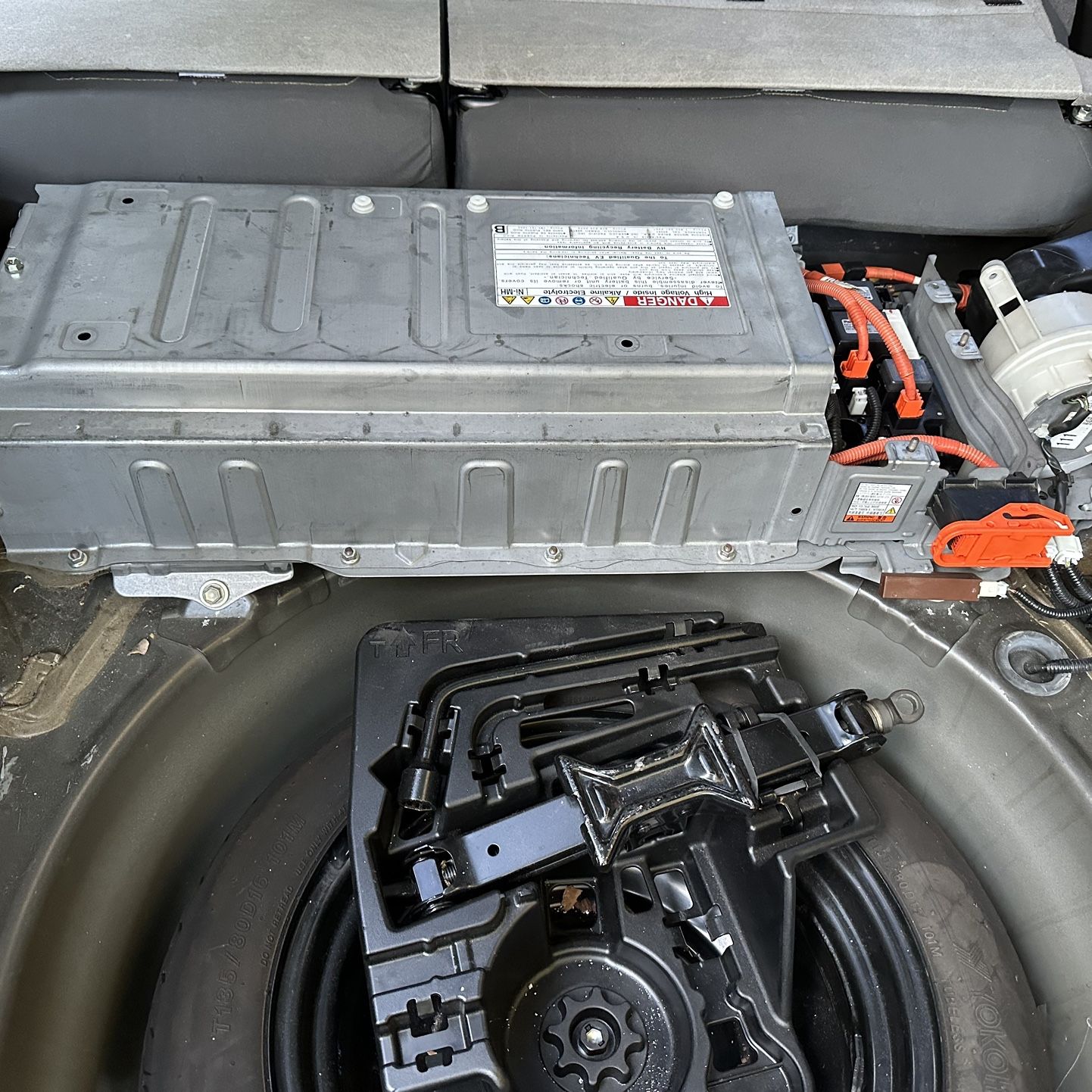
Buying a used Prius or Aqua in Pakistan, the first question every owner asks is the same: how long will the battery last? The honest answer is that the battery does not have a fixed clock — it has a temperature and usage clock, and both run faster in Karachi than in Japan. This post explains what actually wears a hybrid pack out, what lifespan you can realistically expect, and the maintenance habits that genuinely extend it.
What the manufacturer says versus what Karachi does
Toyota’s NiMH hybrid packs were designed and tested in Japanese conditions, where summer peaks around 30–35°C and driving is mostly gentle. Field data from those markets often shows packs working well for 10–12 years. In Karachi, where under-bonnet and boot temperatures sit above 45°C for months and traffic means long idle periods with the air conditioning running, the same pack typically delivers less. Ageing is not magic — heat simply speeds up the chemical reactions that reduce capacity, and every 10°C rise roughly doubles that reaction rate.
The pack also lives in a sealed compartment with its own cooling fan that pulls cabin air through a duct. When that fan or duct is full of dust, the cells run hotter than the design intends, and capacity fades faster.
Realistic lifespan by usage type
These are the ranges we see in real cars coming through the workshop. Treat them as a guide, not a promise.
| Car and usage | Typical pack life in Karachi | Notes |
|---|---|---|
| Prius, Axio, Fielder, CT200h — private, low mileage | 7–10 years | Gentle use, parked in shade, fan kept clean |
| Aqua, Vitz, Sienta — daily city commuting | 5–8 years | Smaller 144 V pack works harder per kilometre |
| Any hybrid used for ride-hailing or long daily duty | 3–5 years | Deep cycling and heat combined |
| Vezel, Fit, Grace — mixed city and highway | 6–9 years | Depends heavily on cooling-fan condition |
| Note e-Power (lithium-ion) | 5–8 years | Different chemistry, high continuous load |
Notice that the same model can double its life depending on how it is treated. A clean cooling fan and a shaded parking spot are worth more than any additive sold in the market.
The habits that actually extend pack life
- Keep the cooling fan and filter clean. In Karachi we recommend cleaning every 20,000–30,000 km, and more often if you park near a construction site. This is the single most effective step.
- Never block the battery vent. Bags, files and shopping pressed against the rear vent starve the pack of cooling air.
- Use the air conditioning in summer. The pack is cooled by cabin air, so a comfortable cabin means a cooler battery.
- Avoid long parking in direct sun. Shade, a cover or covered parking slows heat ageing noticeably.
- Drive the car regularly. A hybrid left unused for weeks self-discharges unevenly, and the first drive after storage works the pack hard.
- Keep the 12 V battery healthy. A weak auxiliary battery makes the ECU restart and relearn, and it stresses the high-voltage system.
- Ask for a capacity test every year after year five. Catching one weak block early is cheap. Catching five is not.
Service intervals worth noting
| Item | Suggested interval |
|---|---|
| Battery cooling fan and duct clean | Every 20,000–30,000 km |
| Full hybrid battery capacity test | Yearly after the pack turns five |
| Inverter coolant check and top-up | As per schedule, usually every 40,000 km |
| Hybrid battery replacement | Only when testing shows it is needed |
Why a hot pack loses capacity first, and voltage later
Inside an NiMH module, the cell’s internal resistance rises as it ages. Higher resistance means more heat for the same current, and more heat means faster ageing — a loop that runs fastest in summer traffic. In the early stage you only notice a slightly weaker EV range. Later, resting voltage between modules drifts apart, the fan runs more often, and eventually the ECU flags a weak block. This is why a capacity test at year five tells you more than a voltage reading at year eight.
Lithium-ion packs, like those in the Note e-Power or in a converted Prius, age differently. They tolerate heat better in ordinary use but degrade quickly if they are regularly charged at high temperature or run at very high load. Lithium is not automatically longer lasting — it is simply sensitive to different things.
Book a check
If your car is over five years old or your fuel average has slipped, message us on WhatsApp at +92 308 8140743 with your model and year. We test pack capacity and module balance in front of you at our workshop in D.H.A Phase 2, Karachi — Shop 1, Ground Floor, Plot 36-C, 21st Commercial Street — Monday to Saturday, 8:00 am to 10:30 pm. Ghar tak service is also available inside Karachi.
FAQ
Can I make a hybrid battery last 15 years in Karachi?
It is possible but uncommon, and it depends on shade, mileage and cooling-fan care. Realistically, plan for a replacement or reconditioning somewhere between years six and ten, and be pleasantly surprised if you get longer.
Is it bad to park my hybrid for a month while travelling?
Yes, long idle periods are harder on the pack than daily driving. If you must leave the car, park it in shade, do not leave it fully charged, and ask someone to start and drive it briefly every week or two if possible.
Does a reconditioned pack last as long as a new one?
A properly reconditioned pack with capacity-matched modules can serve well for years, but the remaining original modules are still ageing. A new imported pack with warranty is the more predictable option for long-term ownership.
Need this checked on your own car?
Message us on WhatsApp with your model, year and what the car is doing. We will give you a realistic answer, and a price only if work is genuinely needed.