
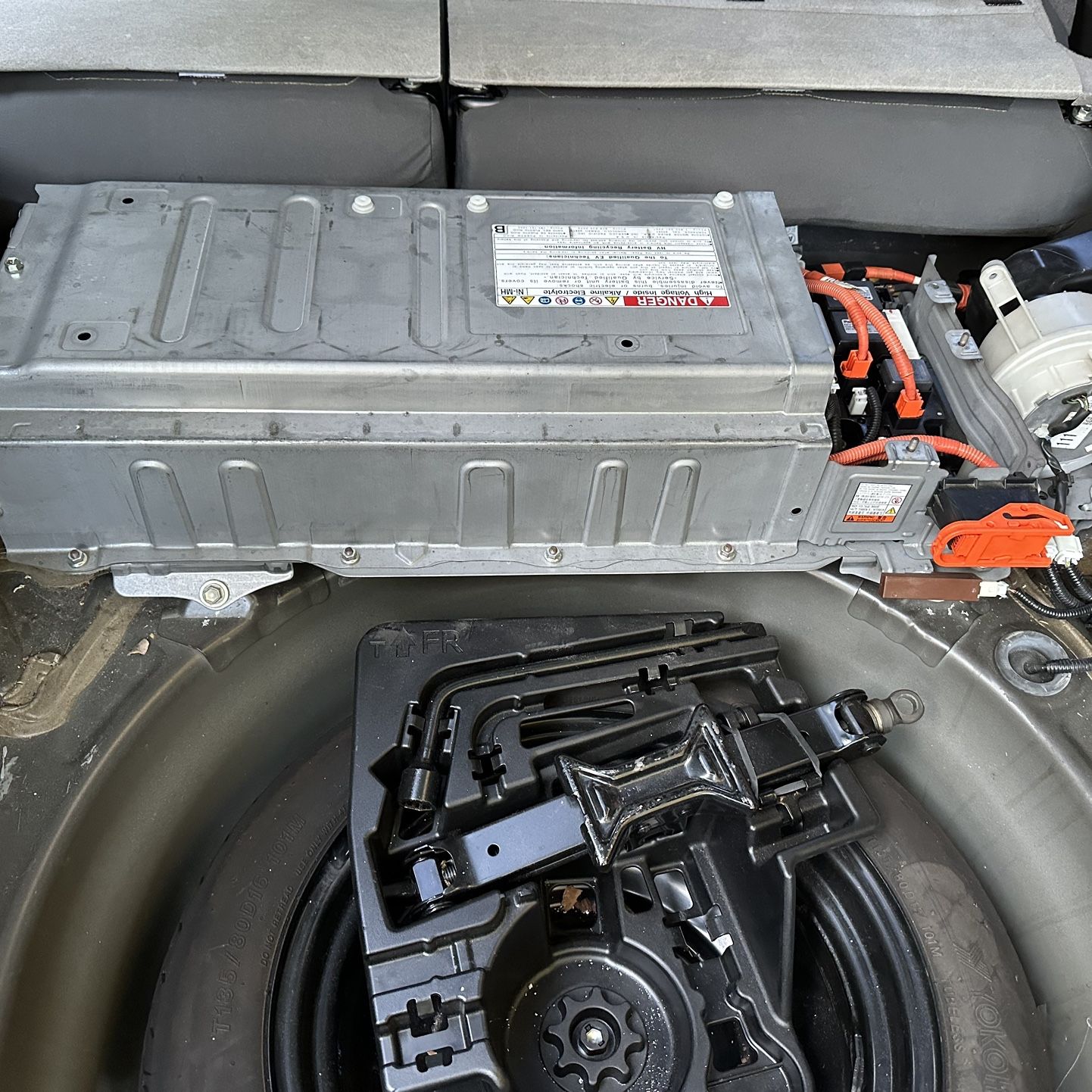
When a hybrid battery starts to go weak, it rarely fails all at once. It gives you small hints first: the battery gauge drops faster than it used to, the engine stays on longer at signals, and your fuel average slowly slides down. In Karachi’s heat those hints show up earlier than most owners expect.
We scan Prius, Aqua, Axio, Fielder, Vitz, Vezel, Fit, Grace, CT200h and Note e-Power hybrids at our D.H.A Phase 2 workshop every week, and the same pattern repeats. Here is what to watch for, what each symptom actually means inside the pack, and when a proper battery test is worth your time.
The battery gauge tells you more than the warning light
On a healthy Toyota or Honda hybrid, the state-of-charge bars should move smoothly and settle around the middle of the display during normal city driving. A weak pack gives itself away like this:
- The bars fall from six to two within a few minutes, then jump back up as the engine recharges.
- Bars move in sudden steps instead of sliding gradually.
- The car refuses to stay in EV mode for more than a few seconds, even on flat road.
- The green EV light cuts off the moment you touch the accelerator.
This happens because the ECU estimates state of charge from pack voltage. One weak module — on most Toyota NiMH packs each module is roughly 7.2 V, made of six 1.2 V cells in series — collapses under load, so the voltage sags, the ECU thinks the pack is nearly empty, and it forces the engine on to recharge. Nothing is actually empty. The pack has simply lost the ability to hold voltage while working.
The engine starts doing all the work
A healthy Prius or Aqua spends a large part of city driving with the engine off. As the pack ages, the balance shifts:
- The engine runs constantly, even while you wait at a red light.
- Fuel average falls from around 18–22 km/l towards 12–14 km/l.
- The car feels slow to pull away, and the engine revs more for the same speed.
- The engine seems to charge the battery more than it drives the wheels.
Spark plugs and filters are worth checking first, but if they are fine and the bars are restless, the pack is the likely culprit.
Warning messages and stored fault codes
As degradation gets worse, the dashboard joins in. You may see the master warning triangle with “Check Hybrid System” or “Check Hybrid Battery”. Sometimes the message disappears after a restart, which makes owners think the problem is solved. Usually it is not — the code is stored, and the weak block is still weak.
Common codes we find on the scanner:
| Code | Meaning | What it usually indicates |
|---|---|---|
| P0A80 | Replace hybrid battery pack | Average module capacity has dropped below the ECU threshold |
| P3011–P3019 | Battery block became weak | One or more blocks hold noticeably less capacity than the rest |
| P0A7F | Hybrid battery pack deterioration | Gradual, widespread capacity loss across the pack |
| P0AFA | Hybrid battery system voltage low | Severe voltage sag, often on a hot or heavily degraded pack |
Any of these with a hot battery compartment deserves attention the same week.
Heat, noise and physical signs
NiMH packs are sensitive to temperature, and Karachi summers are hard on them. Watch for:
- The battery cooling fan running loudly or continuously behind the rear seat.
- Dust blocking the fan and duct — on its own this can trigger overheating codes.
- A hot or sulfuric smell near the battery, which can mean a cell is venting. Stop driving and have it checked.
- White or blue powder on terminals and busbars, or swollen modules once the pack is opened.
Not every car fails the same way
Toyota and Lexus hybrids (Prius, Aqua, Axio, Fielder, Sienta, Camry, C-HR, Corolla Cross, CT200h, RX450h) use NiMH packs that mainly lose capacity with age and heat. Nissan’s Note e-Power is different: it runs a small lithium-ion pack at high load, so its failure signs lean towards sudden power loss and warning lights rather than a slowly wandering gauge. Whatever the badge on the boot, the test is the same — measure capacity, not just voltage.
What a real diagnosis looks like
A quick voltage reading is not enough. A proper test includes capacity and internal-resistance measurement at rest and under load, block-by-block voltage comparison, cooling fan and temperature-sensor checks, and a look at the ECU’s stored history. Clearing the code and selling the car is not a repair — bilkul, the weak block is still there, and it will come back.
Book a check
Send us a WhatsApp on +92 308 8140743 with your car model, year and any warning message, and we will tell you whether a scan is needed. We are at Shop 1, Ground Floor, Plot 36-C, 21st Commercial Street, D.H.A Phase 2, Karachi, open Monday to Saturday, 8:00 am to 10:30 pm. Doorstep service across Karachi is available too, In Sha Allah.
FAQ
How long can I keep driving with a weak hybrid battery?
Most cars keep moving for weeks or even months, especially in cooler weather, but performance and fuel average keep dropping. In Karachi summer, heat stress can push a marginal pack into a hard fault quickly, so testing early is better than being stranded on the road.
Will one bad module damage the rest of the pack?
Yes. Because the modules are in series, the weakest one limits the whole pack, and constant deep cycling accelerates wear in the remaining healthy modules. Replacing a weak module early, with proper capacity matching, usually costs far less than waiting for a full replacement.
Do warning lights always appear when the battery is failing?
No. Many failing packs never set a light. They show up as poor fuel average, short EV range and constant engine running. That is exactly why we test by capacity rather than relying on fault codes alone.
Need this checked on your own car?
Message us on WhatsApp with your model, year and what the car is doing. We will give you a realistic answer, and a price only if work is genuinely needed.